
Pit Lake Iterative Simulation Model, or PLISM, is an Excel workbook for simulating pit lake formation. Open-pit mines that extend below the water table create pit lakes. Assessing post-mining, pit-lake recovery and geochemistry requires a model that simulates time-dependent inflow and outflow components. The transient pit-lake model, PLISM, is a water-balance model that simulates groundwater exchange with the Jacob-Lohman equation (Lohman, 1972; Fontaine and others, 2003). Precipitation, highwall runoff, evaporation from the pit lake (E), and external flows from pumping or injection also are flow components of the water budget in addition to groundwater exchange. Lake stage is related to surface area and volume of the pit lake with lookup tables of pit geometry.
Pit Lake Water Balance
Pit-lake water-balance components are categorized as “net pumping”, climate, and groundwater components (Figure 1). These components are specified or computed as the water balance is solved transiently for changes in pit-lake stage, area, and volume (Jackson and others, 2026).
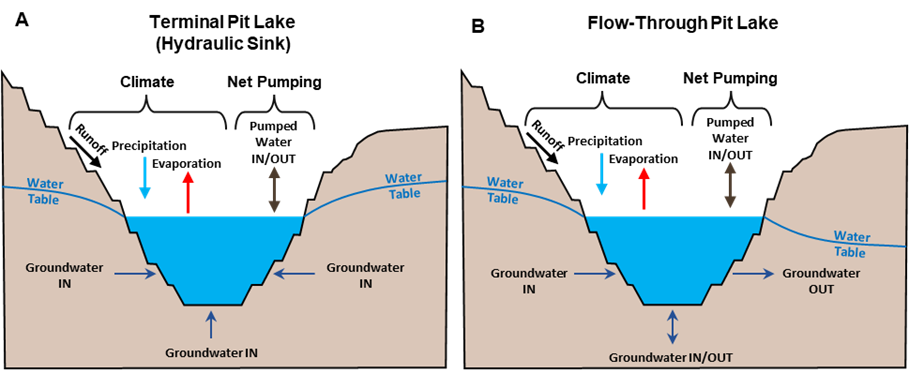
The “net pumping” component sums all mine-related inflows and outflows, which are user-specified inputs that typically are measured quantities from flowmeter readings. The “net pumping” term accounts for any site-specific condition that contributes to the water balance. Two examples include pumping contact water from other mine facilities to the pit lake or pumping water from the pit lake to a water treatment plant (Jackson and others, 2026).
Climate components include direct precipitation on the pit lake, surface-water runoff to the pit lake, and evaporation from the pit lake (Figure 1). Flow rates of these three climate-related terms depend on the pit-lake surface area, which changes dynamically as the pit stage changes. Climate components are estimated dynamically in PLISM by interpolation from the open pit stage-area-volume (SAV) table (Jackson and others, 2026).
The groundwater exchange component is computed from the Jacob and Lohman (1952) solution, where flow between pit lake and aquifer is defined by transmissivity, storage coefficient, and pre-mining groundwater level (Jackson and others, 2026). The Jacob-Lohman well function, G(α), is approximated with a simplified solution (Perrochet, 2005).
PLISM Numerical Approach
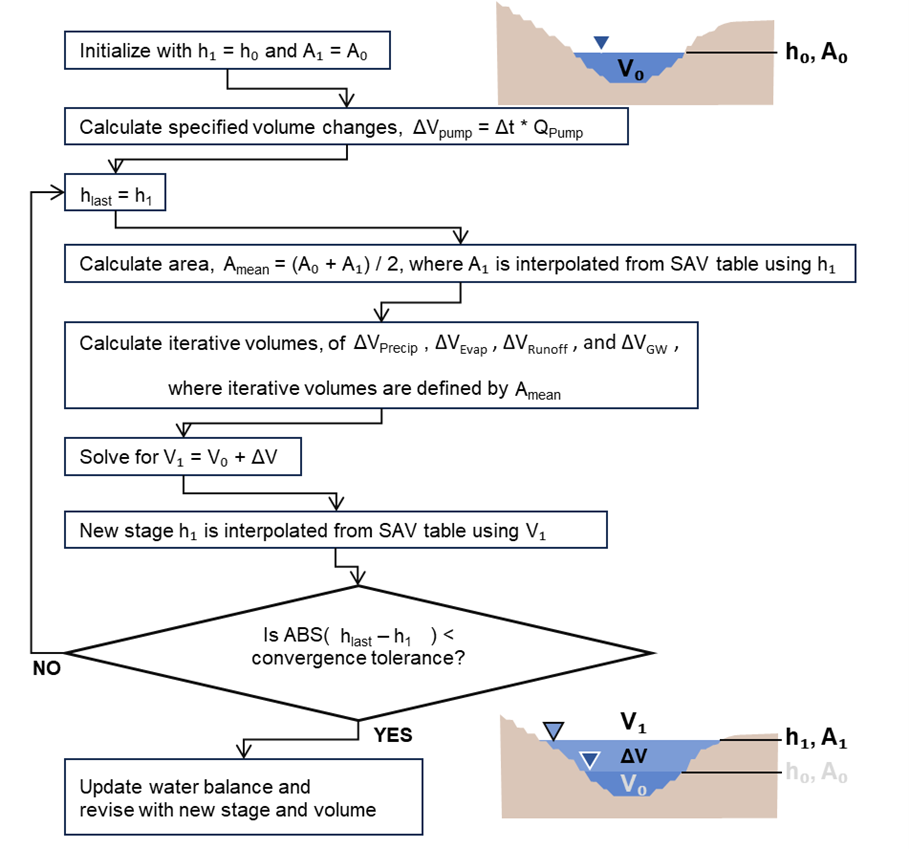
Lake stage is simulated with a water balance approach that iteratively solves for lake volume and stage. Lake volume at the end of a time step is estimated initially with the surface area at the beginning of the time step. Surface area of the pit lake affects estimated precipitation, highwall runoff, E, and groundwater exchange volumes during a time step. Lake stage at the end of a time step is interpolated from the user-defined stage-area-volume relation. A revised lake volume at the end of the time step is estimated with a revised surface area from estimated lake stage at the middle of a time step. This process is repeated until estimated lake stages converge on a single value (Figure 2).
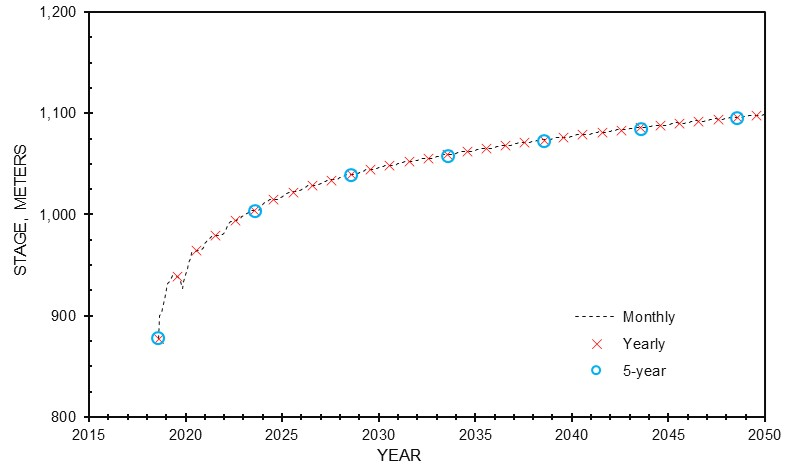
Lake stages estimated with PLISM are relatively insensitive to duration of time steps. Time steps for simulating lake stages are independent of times when precipitation and E are tabulated. Precipitation and E are specified as lengths (volume per unit area) during tabulated periods. These periods could be a month, a year, or 10 years, which would be lengths of 1, 12, and 120 inches, respectively, for rates of 12 in/yr. Monthly precipitation and E are integrated if simulation periods are annual and interpolated if simulation periods are less than data tabulation periods. For example, lake stages were simulated for the pit lake characterized at Buzwagi Gold Mine, Tanzania (Jackson and others, 2026). Simulated lake stages differed little regardless of using monthly, yearly, and 5-year time steps (Figure 3). The maximum difference between solutions was less than 1 percent of the recovery range and errors did not propagate.
Data tabulation, pit-lake representation, and solution method in PLISM differs from traditional water balance models such as CRYPTIC (Fontaine and others, 2003). Data tabulation and lake-stage simulation times can differ in PLISM. Surface area and volume of pit lake are tabulated with lake stage. Stage-area-volume relation in PLISM is interpreted as a continuous function rather than as a limited series of discrete cylinders. Pit-lake stages and volumes are solved iteratively with PLISM rather than with forward differences. PLISM simulates highwall runoff as a function of pit-lake stage, which decreases potential runoff as lake stage increases.
Future Predictions
Future predictions of pit-lake stages and volumes require predicted rates of all water-balance inputs. Net pumping components are user-defined inputs based on site operational plans or water management scenarios. Precipitation, evaporation, and surface-water runoff are readily forecast from climate data. For future climate predictions, the default methodology in PLISM is to use the historic record of precipitation and evaporation to compute long-term averages. These long-term averages are projected into the future for pit-lake water management scenarios assuming an average climate condition. Alternatively, predicted precipitation and evaporation can be estimated with external models, where results supplant the projected long-term averages.
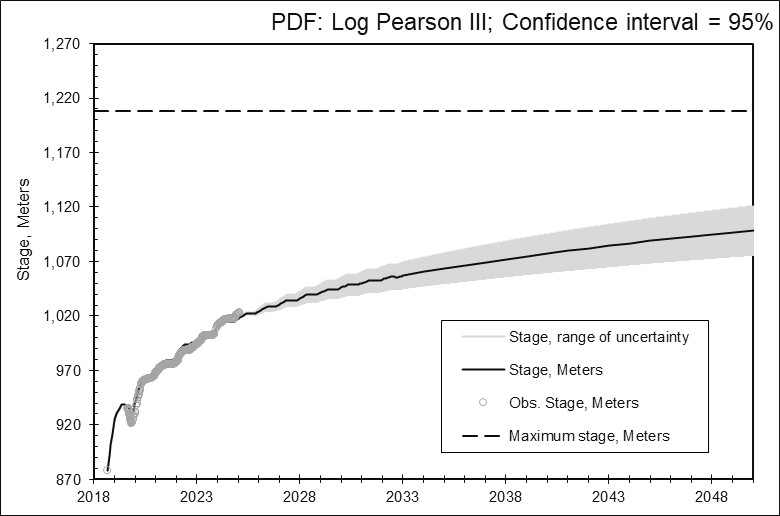
Uncertainty in predicted pit-lake stages and volumes principally reflects uncertainty in precipitation forecasts. Uncertainty of annual precipitation is estimated with the log-Pearson Type III distribution, which is used prevalently for flood-frequency analysis (Interagency Advisory Committee on Water Data, 1982; Gotvald and others, 2012; England and others, 2018). Uncertainty of annual precipitation usually is reported as a range where 90 or 95 percent confidence exists that annual precipitation during a given year will be within the estimated range.
Uncertainty in predicted pool stages and free-water volumes are estimated with alternative models that simulate minimum and maximum precipitation within a specified confidence interval. Predicted precipitation in these alternative models scales long-term monthly averages by the ratio of predicted to average annual volumes of precipitation, which preserves seasonal variations in precipitation. For example, annual precipitation averaged 898 mm at the Buzwagi Gold Mine, Tanzania (Jackson and others, 2026). The 95-percent confidence interval of annual precipitation from this distribution ranged between 581 and 1,273 mm. Predicted pool stages depart about 22 m from the average simulated pool stage after 30 years of recovery, which is about 10 percent of the mean change in stage during recovery (Figure 4).
PLISM workbook features
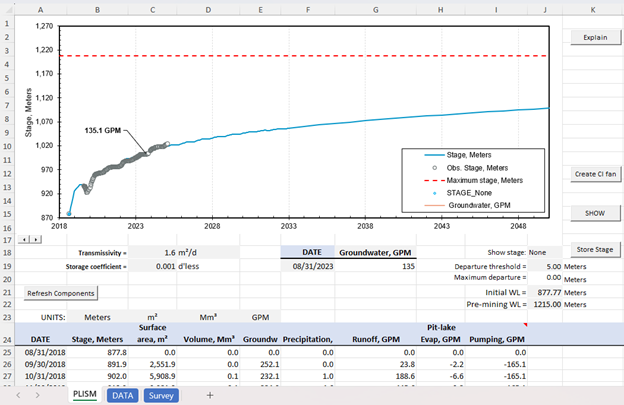
The workbook consists of three visible pages, PLISM, DATA, and SURVEY (Figure 5) and three hidden pages, FAN, CONTROL, and TRACK. Transmissivity, storage coefficient, and pre-mining and initial pit-lake water levels are specified on the PLISM page. Simulated pit-lake stage, area, volume, and flow components are reported on the PLISM page (Figure 5). SAV relations, runoff characteristics, time series of precipitation and evaporation (E) rates, and time series of volumetric pumping or injection rates are entered on the DATA page. Surveyed stages are specified and interpreted pool areas, and free-water volumes are reported on the Survey page.
Hidden pages, FAN, CONTROL, and TRACK largely support internal PLISM calculations, which users should not need to edit. FAN page is a template for uncertainty analysis in a new workbook that is created by the Create CI fan button. CONTROL page contains lookup tables, unit conversions, charting utilities, and call to water-balance function. TRACK page stores alternative stage simulations that can be managed with a utility on the TRACK page.
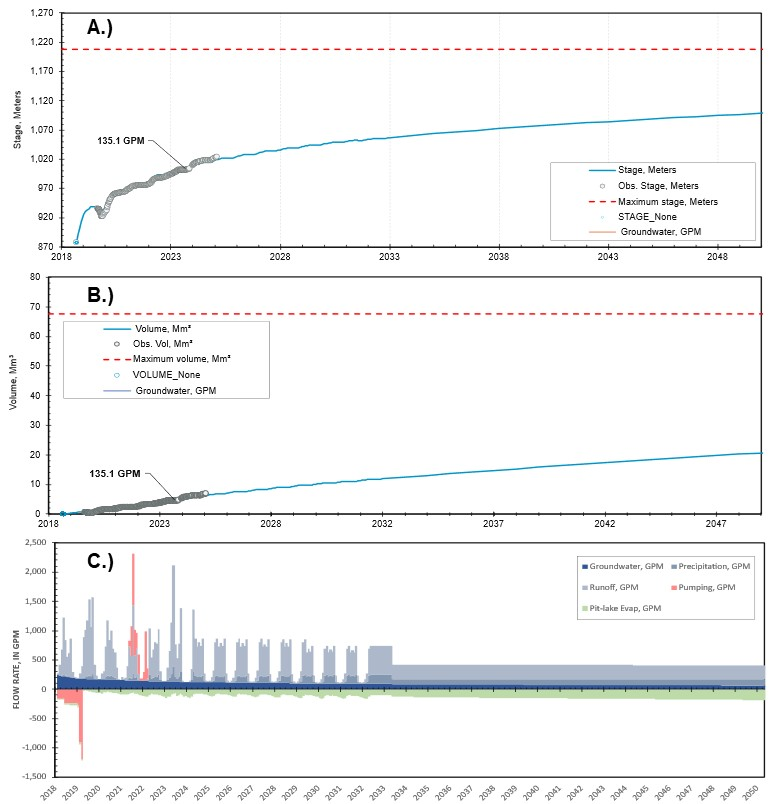
Water balance of the pit lake principally is analyzed from the PLISM page (Figure 5). Surveyed and simulated stages can be compared and differences minimized by adjusting transmissivity and storage coefficient on the PLISM page (Figure 6; A). Surveyed and simulated free-water volumes also can be compared while minimizing differences (Figure 6; B). A third chart also exists that displays flow rates for each water-balance component by time step (Figure 6; C). Display areas of these three charts are maximized by being stacked on top of one another so that only one chart is visible at a time (Figure 5). Chart visibility is changed by a spin button (cell A17) that moves charts up or down in the stack.
Macros were developed in Microsoft Excel® 365 and are not backward compatible to earlier versions of Excel. This is because user-defined functions use previously unavailable SPILL functionality to return two-dimensional arrays.
VBA macros & Trust Center
More macro functions default to being disabled through either Microsoft updates or IT departments engaging in their natural function. Please check your Trust Center settings.
Download
The file PLISM.v8a.zip contains,
- PLISM.v8a.xlsm – Workbook with macros for simulating water balance of a pit lake;
- Buzwagi_FullRainfall-StormAnalysis.xlsx – Example of annual precipitation analysis to estimate range of predicted pit-lake stages; and
- PLISM-EXPLAIN.v8a.pdf – Explanatory document.
Revisions
January 31, 2020—Version 1-4, Initial release.
March 23, 2025—Revisions in version 5 include the following. Added missing conversion factor to initial pit-lake stage. Thanks to Jamie Cutting of CEG Laboratories for identifying this error.
December 22, 2025—Revisions in version 6 include the following. PLISM workbook overhauled to parallel TSFISM workbooks, where stage, area, volume, and flow components are computed in a single call and returned as an Excel range.
February 11, 2026—Revisions in version 7 include the following. Revised supporting document with references to PLISM article in Jackson and others (2026).
April 16, 2026— Revisions in version 8a include the following. Corrected errors in catchment-runoff table and reduction routine for SAV tables.
Suggested Citation
Jackson, T.R., K.J. Halford, and Guosheng Zhan, 2026, Pit-Lake Iterative Simulation Model (PLISM): An Iterative Solver, Mine Water and the Environment, https://doi.org/10.1007/s10230-026-01100-4
or
Halford, Keith, 2026, Analytical_PLISM–An Excel workbook for simulating water balance of a pit lake, version 8, Halford Hydrology LLC web page, accessed April 2026, at https://halfordhydrology.com/plism/
References
England, J.F., Jr., Cohn, T.A., Faber, B.A., Stedinger, J.R., Thomas, W.O., Jr., Veilleux, A.G., Kiang, J.E., and Mason, R.R., Jr., 2018, Guidelines for determining flood flow frequency — Bulletin 17C (ver. 1.1, May 2019): U.S. Geological Survey Techniques and Methods, book 4, chap. B5, 148 p., https://doi.org/10.3133/tm4B5
Fontaine, R.C., A. Davis, and G.G. Fennemore, 2003, The Comprehensive Realistic Yearly Pit Transient Infilling Code (CRYPTIC): A Novel Pit Lake Analytical Solution, Mine Water and the Environment v.22 pgs. 187–193 https://doi.org/10.1007/s10230-003-0021-z
Gotvald, A.J., Barth, N.A., Veilleux, A.G., and Parrett, C., 2012, Methods for determining magnitude and frequency of floods in California, based on data through water year 2006: U.S. Geological Survey Scientific Investigations Report 2012–5113, 38 p., 1 pl., https://doi.org/10.3133/sir20125113
Interagency Advisory Committee on Water Data, 1982, Guidelines for determining flood flow frequency: Hydrology Subcommittee Bulletin 17B, 28 p., 14 app., 1 pl. https://water.usgs.gov/osw/bulletin17b/dl_flow.pdf
Jackson, T.R., K.J. Halford, and Guosheng Zhan, 2026, Pit-Lake Iterative Simulation Model (PLISM): An Iterative Solver, Mine Water and the Environment, https://doi.org/10.1007/s10230-026-01100-4
Share link: https://rdcu.be/e3tHY
Jacob, C. E., and Lohman, S. W., 1952, Nonsteady flow to a well of constant drawdown in an extensive aquifer: Am. Geophys. Union Trans., v. 33, p. 559-569. https://agupubs.onlinelibrary.wiley.com/doi/abs/10.1029/TR033i004p00559
Lohman, S.W., 1972, Ground-Water Hydraulics: U.S. Geological Survey Professional Paper 708, 70 p. https://doi.org/10.3133/pp708
Perrochet, P., 2005, A simple solution to tunnel or well discharge under constant drawdown. Hydrogeology Journal 13:886–888. https://doi.org/10.1007/s10040-004-0355-z